
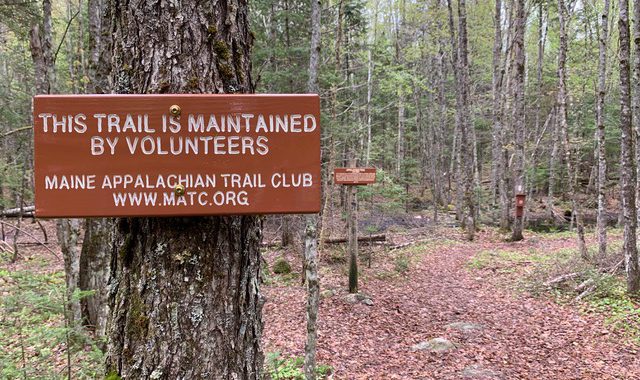
ATC’s blog post from July 28 tells the story of a day in the life of an A.T. volunteer; getting up early on a day off to move rocks, cut brush, and swat bugs. All for a whopping paycheck with lots of zeros, including a leading zero… But the rewards are tremendous and have lasting impacts. Featured in the ATC blog post is MATC legend Dave Field; he’s been maintaining and protecting the A.T. for over 50 years! Be sure to scroll down the page to read about Dave, and watch the “myATstory” short film on his lifetime of efforts!

COVID-19 Guidelines for Maintainers and Monitors
The National Park Service has issued guidelines that allow us to resume our trail and campsite maintenance as well as boundary monitoring during the COVID-19 pandemic. This is great news! However, there are a few tasks to complete before heading out, and guidance to work within while on the trail so that we remain as safe as possible.
Volunteers need to watch a video and complete an on-line acknowledgement form to demonstrate that you have read, acknowledge, and agree to follow actions to improve safety found in the COVID-19 JHA (Job Hazard Analysis) and training. This means that before you can work on the trail, campsites, or boundary, every maintainer and monitor needs to go to ATC’s “Volunteer Protocols During COVID-19” page (https://appalachiantrail.org/get-involved/volunteer/safety/covid-19/) and:
- View the 17-minute on-line training video
- Read and be familiar with the guidelines and links including the one-page reference chart
- Complete the online “Re-Engagement Acknowledgement – COVID-19” form
This is required not only ourselves, but any person that goes out on the trail, campsite, or boundary with us.
If you are not comfortable performing your maintainer or monitor duties in these conditions, you are under no obligation to complete them. Please let us know so we can adjust.
Campsite maintainers: Please use the revised campsite maintainer tip sheet for campsite tasks (https://www.matc.org/assets/Campsite-Maintainer-Tip-Sheet_COVID-19.pdf). Please do not perform the following:
- Privy maintenance
- Lean-to maintenance
- Trash clean-up
If you are going out by yourself or with someone from your “household” to maintain the trail, campsites, or boundary then it is a little easier to make sure you are safe. If you have someone from outside of your “household” accompany you, which is recommended in general, then you become a “trip leader” and have to take some additional precautions. These include:
- No sharing tools
- No carpooling
- No sharing food or drinks
- Maintaining social distancing
Please contact your Overseer with any questions.
Thank you for your dedication to the AT!
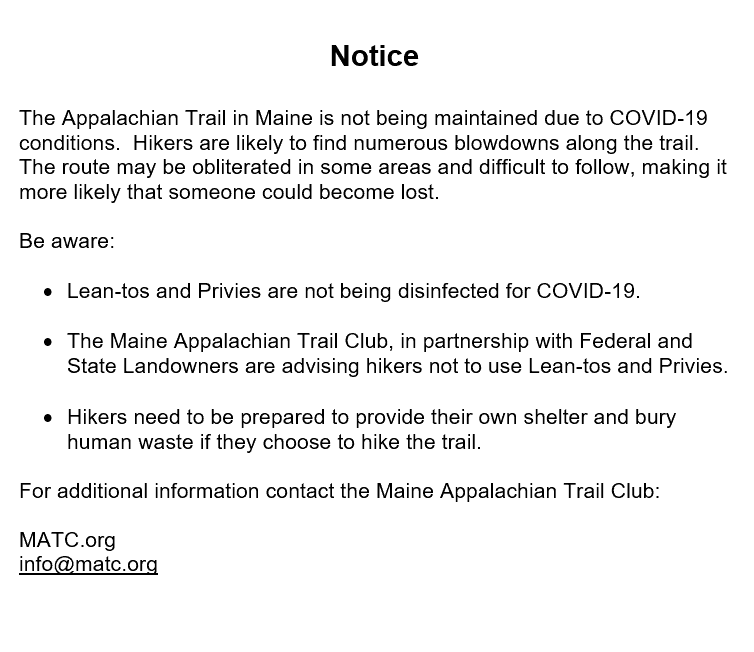
COVID-19 Advisory Posted on Maine AT
Please be aware that the following sign will be posted at Maine AT trailheads in the coming days.
June 16, 2020 Update on A.T. Closures and Conditions
From Appalachian Trail Conservancy Bulletin 6/16/2020
With more states relaxing stay-at-home restrictions and more sections of the Appalachian Trail (A.T.) reopening, the Appalachian Trail Conservancy (ATC) is due for a check-in with the hiking community and wanted to provide the latest status update for the A.T.
As of today, all but 5.2 miles of the A.T. have re-opened, leaving only the northernmost A.T. miles on Katahdin closed (which is expected to open July 1). In our previous email, we listed three criteria any one of which, if met, would cause the ATC to re-evaluate its guidance. We are close to meeting one of these criteria: that all official closures on the A.T. resulting from the pandemic are removed.
However, some complications also exist:
- Overnight camping challenges: The entirety of the A.T. in two states (New Jersey and Massachusetts) remains closed to all overnight camping. All designated overnight sites remain closed in Vermont and New Hampshire with legal and sustainable dispersed camping sites in those states difficult to find. Additional sections of the A.T. in Maine and Pennsylvania remain closed to camping. Most shelters remain closed. Please be aware that in some areas, these closures have not been posted on the ground.
- New COVID-19 infections: While most states are seeing a downward trend in COVID-19 cases, some states are still mitigating the continued impact of the pandemic. Currently, a required or recommended 14-day quarantine remains in place in Vermont, New Hampshire and Maine for some or all visitors (with some caveats to shorten the quarantine length).
- Volunteer maintenance: The Trail is a volunteer-maintained resource and we are waiting for the federal government to approve protocols and sign new agreements to send volunteers back to the Trail. Volunteers have asked for the opportunity to catch up on a backlog of maintenance and clean-up before hikers are encouraged to hit the Trail, and we want to honor that.
Within the next few weeks, we believe it likely the ATC will recommend hikers, including thru-hikers, return to the Trail assuming there are no significant negative changes in the current trends.
For thru-hikers planning a modified hike plan after a long-delayed start, a southbound thru-hike (where a June or July start is typical) is not necessarily the best alternative. Not only is this — by far — the most difficult way to start a thru-hike; this year there are even more logistical challenges in getting to and into Baxter State Park, including reduced overnight capacity in a park that is completely booked much of the summer. This year has also been a late-snow year, so removal of blowdowns and other spring maintenance in rugged and challenging terrain will be even further delayed.
Once our recommendations change, thru-hikers can start or resume their hikes anywhere. We encourage thru-hikers to self-disperse, which will help minimize impacts to the Trail and volunteers and help reduce the potential spread of COVID-19. Also, thru-hikers who left the Trail in March and stayed off to reduce the spread of the virus will have an additional 12 months to complete their thru-hikes once they resume their hikes, after we’ve given the okay to return. We emphasize all thru-hikers on the A.T. be as self-reliant as possible, staying away from shelters, privies, and other public facilities and carry a personal shelter, a bear canister, and equipment for proper catholing. Check our website for tips on thru-hiking and selecting a start location.
We will communicate any updates as soon as decisions are made. In the meantime, we invite you to monitor our A.T. Closures page and Johns Hopkins University’s Coronavirus New Case Trends By State.
We thank you for your patience and encourage you to review our Plan and Prepare, Leave No Trace, and COVID-19 guidance while you are waiting.

Volunteer Opportunities Cancelled Summer 2020

Covid-19 (commonly referred to “coronavirus”) is a highly contagious respiratory virus has been diagnosed in all of the states along the Appalachian Trail, including Maine. Due to the high risk of spreading this illness in group settings the Maine Appalachian Trail Club has made the tough decision to discontinue the Maine Trail Crew, in 2020, to keep our staff and volunteers safe. We are concerned about the risk of spreading the virus when crew members travel together in vans, share housing, food, tools and privies. This is disappointing for MATC as an organization and for our many dedicated volunteers. Thank you for understanding. Please consider volunteering with the Maine Trail Crew in 2021.

Support MATC with Amazon Smile
Amazon Smile Program
Did you know we are part of the AmazonSmile Program?
To support us there, visit this page and select “Maine Appalachian Trail Club Inc” as the charitable organization.
AmazonSmile is a website operated by Amazon with the same products, prices, and shopping features as Amazon.com. The difference is that when you shop on AmazonSmile, the AmazonSmile Foundation will donate 0.5% of the purchase price of eligible products to the charitable organization of your choice.
Maine Trail Crew Closure for 2020
Covid-19 (commonly referred to “coronavirus”) is a highly contagious respiratory virus has been diagnosed in all of the states along the Appalachian Trail, including Maine. Due to the high risk of spreading this illness in group settings the Maine Appalachian Trail Club has made the tough decision to discontinue the Maine Trail Crew, in 2020, to keep our staff and volunteers safe. We are concerned about the risk of spreading the virus when crew members travel together in vans, share housing, food, tools and privies. This is disappointing for MATC as an organization and for our many dedicated volunteers. Thank you for understanding. Please consider volunteering with the Maine Trail Crew in 2021.